If Bubble feels too heavy, try a tool that matches the job instead of forcing one builder to do everything. No-code is not a toy anymore. Gartner predicted that by 2025, 70% of new apps would use low-code or no-code tech [source: Gartner]. That means more teams are building portals, internal tools, marketplaces, and SaaS products without waiting six months for dev time.
TLDR: Bubble is great for custom apps, but it can feel slow, complex, and oddly picky. If you need a client portal, Softr can help you ship fast. If you need an internal admin panel, Retool may save 40 to 60 hours of build time on a small project. For example, a small agency could use Airtable plus Softr to launch a paid customer dashboard in two weeks, then move to WeWeb or FlutterFlow later if it needs more control.

1. Softr
Best for: client portals, directories, simple SaaS apps, member sites.
Softr is one of the friendliest Bubble alternatives. It turns data from tools like Airtable, Google Sheets, and SmartSuite into clean web apps. You pick blocks. You connect data. You publish.
It is great for founders who want something that works by Friday. Not next quarter.
The annoying bit? Deep custom logic can feel tight. If your app needs weird workflows, Softr may make you miss Bubble a little.
2. FlutterFlow
Best for: mobile apps, SaaS apps, marketplaces, customer apps.
FlutterFlow lets you build real mobile and web apps using Google’s Flutter framework. The big win is that you can export code. That matters when your app grows up and starts acting like a teenager.
You get visual design, database options, APIs, authentication, and app store support. It feels more technical than Softr, but much more powerful.
Use it if your product needs a polished mobile app. Think booking apps, fitness platforms, delivery tools, or social apps.
3. WeWeb
Best for: polished web apps, SaaS front ends, dashboards.
WeWeb is a slick front-end builder. It pairs well with back-end tools like Xano, Supabase, or Airtable. This split gives you more control than many all-in-one builders.
Designers tend to like it. Product teams like it too. You can build user dashboards, admin panels, and customer portals that do not look like sad templates from 2012.
Honestly, it feels like WeWeb asks you to think more at first. But that pain pays off when your app gets bigger.
4. Glide
Best for: internal tools, mobile tools, field team apps.
Glide is fast. Very fast. If your data is in a spreadsheet, Glide can turn it into an app before your coffee gets cold.
It is perfect for inventory tools, team directories, approval flows, inspection apps, and simple CRMs. Sales teams love it. Ops teams love it. Your spreadsheet-loving manager will act like they invented software.
The catch is… Glide can get pricey as your users and needs grow. Also, heavy custom design is not its strongest area.
5. Retool
Best for: internal business tools, admin panels, support tools.
Retool is not trying to be cute. It is built for serious internal apps. Connect a database. Drag in tables, buttons, forms, and charts. Add logic. Done.
It works well with PostgreSQL, MySQL, MongoDB, APIs, and many business tools. If your team keeps asking developers for “just one small admin screen,” Retool can stop that madness.
It is not the best pick for public SaaS products. But for internal tools, it is a beast.
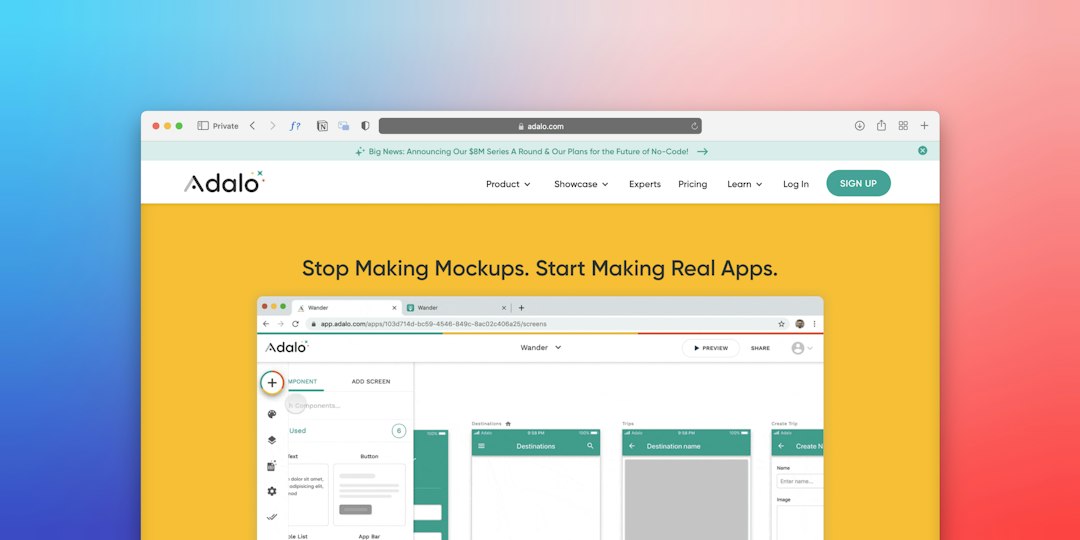
6. Adalo
Best for: simple mobile apps, MVPs, booking apps.
Adalo is easy to understand. You build screens. You add actions. You connect data. It is a solid choice for simple mobile-first products.
Need a local services app? A class booking app? A food ordering MVP? Adalo can get you there without a full tech team.
It drives me a little nuts when simple changes take more clicks than expected. Still, for beginners, it is much less scary than Bubble.
7. Webflow
Best for: marketing sites, SaaS landing pages, content sites, front-end prototypes.
Webflow is not a full Bubble replacement by itself. But it belongs here because many SaaS products need a great front door before they need a huge app.
Use Webflow for landing pages, blogs, pricing pages, and product demos. Pair it with Memberstack, Outseta, Wized, or Xano if you need accounts, payments, or app features.
Webflow is best when design matters. If your SaaS looks sharp, people trust it faster. Fair or not, that is how the internet works.

Quick Pick Guide
- Want the fastest client portal? Try Softr.
- Want a real mobile app? Try FlutterFlow.
- Want a custom SaaS front end? Try WeWeb.
- Want a spreadsheet app? Try Glide.
- Want internal tools? Try Retool.
- Want a simple mobile MVP? Try Adalo.
- Want a beautiful SaaS website? Try Webflow.
When Should You Still Use Bubble?
Bubble is still a strong choice. It is good for custom logic, user accounts, payments, workflows, and complex web apps. If you want one tool to handle most of the product, Bubble can still make sense.
But it has a learning curve. Performance can be tricky. The editor can feel crowded. Expect to waste time on tiny layout issues that should have taken 30 seconds.
Final Take
Pick the tool based on your app type, not hype. That is the simple rule.
If you are building a business tool, start with Retool, Glide, or Softr. If you are launching a SaaS product, check WeWeb, FlutterFlow, or Webflow with a strong back end. If you just need to test an idea, choose the fastest tool and ship.
Your first version does not need to be perfect. It needs to be real. Then users can tell you what to fix.